
Peer review feedback in minutes, not months
Jenni scores your draft against standard peer-review criteria and leaves actionable comments directly in your document. Fix issues before reviewers ever see them.



Beyond Detection: A Framework for Ethical AI Integration in Academic Research
Abstract
The proliferation of generative AI in academic contexts has revealed a fundamental truth that institutions have been reluctant to acknowledge:
AI detection tools achieve accuracy rates often below 80% in independent testing (Wakjira et al., 2025). Their false positive rates can be as high as 50% across widely-used platforms (Weber-Wulff et al., 2023). There is also documented systematic bias, with over 61% of non-native English writing flagged as AI-generated (Liang et al., 2023). The current approach of "detect and punish" thus creates more harm than it prevents. Studies indicate that 13.5% to 22.5% of academic papers now show evidence of AI assistance (Kobak et al., 2025).
The path forward requires abandoning unreliable surveillance in favor of transparency architectures: tools and policies designed from inception to make AI contributions visible, auditable, and appropriately constrained.
Trusted by Universities and businesses across the world





How it works
From draft to peer review feedback in three steps
01
Drop in your draft
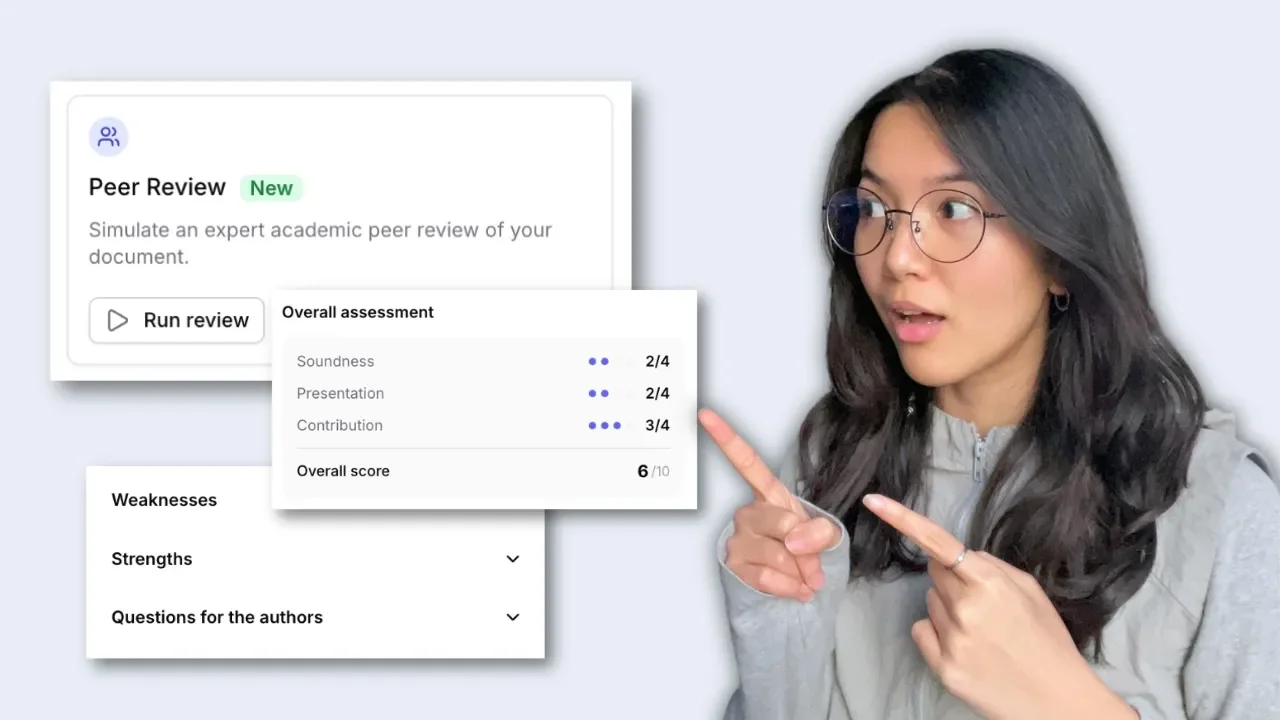
Upload your manuscript as a .docx, paste a section into an existing Jenni document. Peer Review reads the full document end-to-end.
02
Run Peer Review
Jenni reviews your manuscript against standard peer review criteria, scores key areas, and flags actionable improvements directly in your draft.
03
Resolve, re-run, repeat
Comments land directly in your manuscript, tied to the exact passages that need work. Address each issue, and watch your score improve.
HOW IT WORKS
See Peer Review in action
Watch how Jenni reads a real manuscript, scores it against the rubric, and leaves comments where each section needs work.

WHY IT WORKS
Built for academic rigor
Most AI tools give you generic writing feedback. Peer Review evaluates your manuscript like a reviewer would.

Reads the full manuscript
Peer Review reads your full draft cover to cover, capturing every claim, every method note, and every transition, so feedback reflects the whole document.

Same criteria reviewers use
Peer Review fills out the same review form top journals use, with scores on soundness, contribution, and presentation plus written feedback.

Comments tied to passages
Jenni anchors every comment to a specific sentence, with a reason and a suggested fix. You know what to change & where, not just that something's off.
Part of Reviews
Your full pre-submission citation review
Peer Review is one of four Review tools that catch issues before reviewers do. Run them together for a complete pre-submission pass.

Peer review
8 / 10
Manuscript scored against a peer-review rubric with reviewer comments on each section.
Soundness
3/4
Presentation
4/4
Contribution
3/4
Results

Strengths
Weaknesses

Claim confidence
10 issues
The claim confidence analysis addressed issues of redundant, weak, or missing citations, alongside instances of contradiction in citation arguments.
Misrepresented

Contradicted
3
Unsupported
4
Weakly supported
2
Overstated
Unverifiable
Outdated
2
Self-citation heavy
Predatory source
Citation mismatch
1

Proofread
18 edits
Whilst generally sound, the text contains some areas for improvement to comply with academic best practices.
Word choice
All
The majority of
Formality
which was interesting.
.
Grammar
be effective.
appears to be effective.
Transitions
Also,
In addition,
Overgeneralized
All
The majority of
The results provesuggest that X has an effect on Y.

Tone of voice
22 notes
Suggestions across vocabulary, syntax, punctuation, tone and flow to keep a consistent academic voice.
All Suggestions
22
Vocabulary
6
Syntax
5
Punctuation
4
Tone
3
Flow
4


Peer Review
Claim Confidence
Proofread
Tone of Voice

"The Claim Confidence feature is super useful. It flags any unsupported, overstated, or weakly supported claims."

Sabine Hossenfelder
Physicist & Author of Lost in Math
"I regularly try AI tools for research and have found Jenni the best and easiest to use. Especially for rapdily re-formatting references and developing new paper ideas."

Gareth
Editor-in-chief, Taylor & Francis
Published with Jenni
Our users have published papers in 100+ journals
Real research, published in journals such as IEEE, Springer, Elsevier –planned and written in Jenni.

Frequently asked questions
How does the AI actually verify a claim — what's it comparing?
It compares each cited claim against the full text of the source it points to — not the abstract, not the metadata. Verdicts are sorted along four dimensions reviewers actually care about: whether the source supports the claim at all, the scope of the support (population, setting, timeframe), the strength of certainty (proves vs. suggests), and the accuracy of attribution. The exact source passage is shown alongside every verdict, so you can audit the reasoning rather than take it on faith.
Can it check non-English sources?
Yes, Jenni supports all languages.
Does it work with sources behind paywalls or in my institutional library?
Claim Confidence has access to your Jenni library uploads, 10M+ Open Access papers, and citations from major scholarly sites. For paywalled papers you can access through your institution, upload the PDF to your library and Claim Confidence will use it. For sources it can't access at all, the claim is marked Unverifiable so you know to check it manually.
What if a flagged claim is actually correct and the verdict is wrong - can I dismiss it?
Absolutely. Click Dismiss on any verdict and it's gone - no record of the disagreement is kept on your draft. You can also leave a note explaining the dismissal for your future self or collaborators. Claim Confidence is a second pair of eyes, not a gate.
What if a source I cited has been retracted or updated since I wrote my draft?
Claim Confidence checks against the version it can locate at the time of the review — usually what you want before submission. Significant version changes and retraction notices are surfaced alongside the verdict, so you find out before your reviewers do.
Will running a review change my draft automatically?
No. Claim Confidence is read-only on your draft. It surfaces verdicts and suggested rewrites, but every change is your decision — accept, edit, or dismiss. Your original stays intact until you choose to apply a fix.
What's the difference between "Weakly Supported," "Overstated," and "Misrepresented"?
Weakly Supported: the source supports your claim, but in a narrower context than your phrasing implies (e.g., one population, one method). Overstated: the source supports a softer version — the paper says "may contribute to" and you wrote "causes." Misrepresented: the source doesn't actually say what you've attributed to it — the gap is bigger than tone or scope. Each verdict comes with the exact source passage and a suggested rewrite, so the fix is usually a small edit rather than a re-search.
Make progress on your greatest work, today
Write your first paper with Jenni today and never look back
Start for free
No credit card required
Cancel anytime
Over 6m
Academics worldwide
5.2 hours saved
On average per paper
Over 15m
Papers written on Jenni