

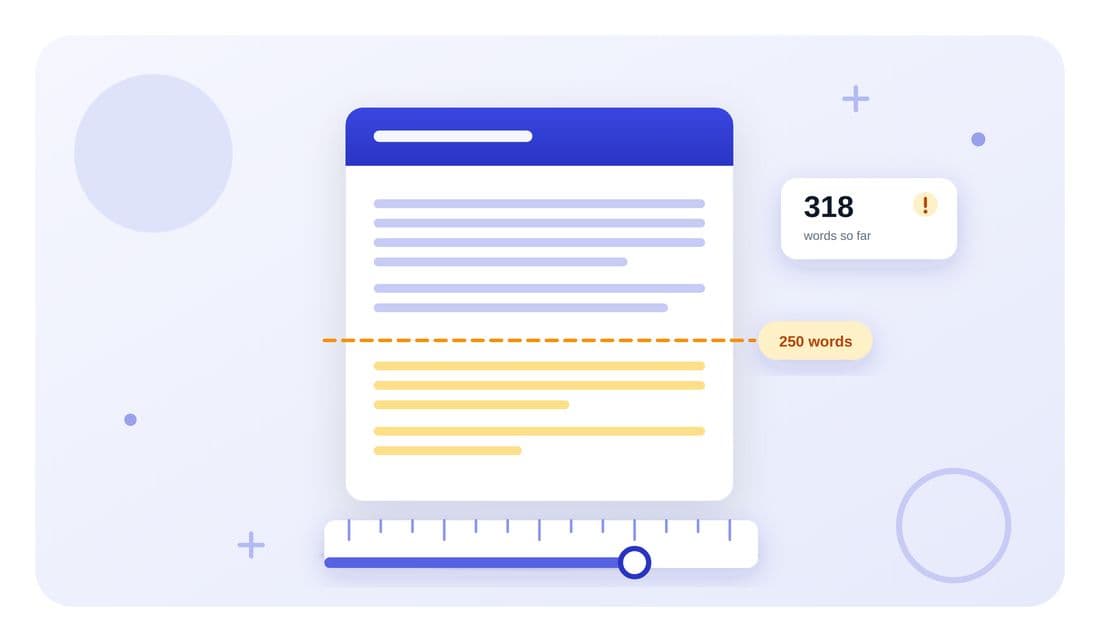
You finish the paper, open the portal, and the counter under the abstract box says 318. The limit says 250.
A lookup guide. The number you need, the real limits at nine venues, and the order to cut in.
The short answer
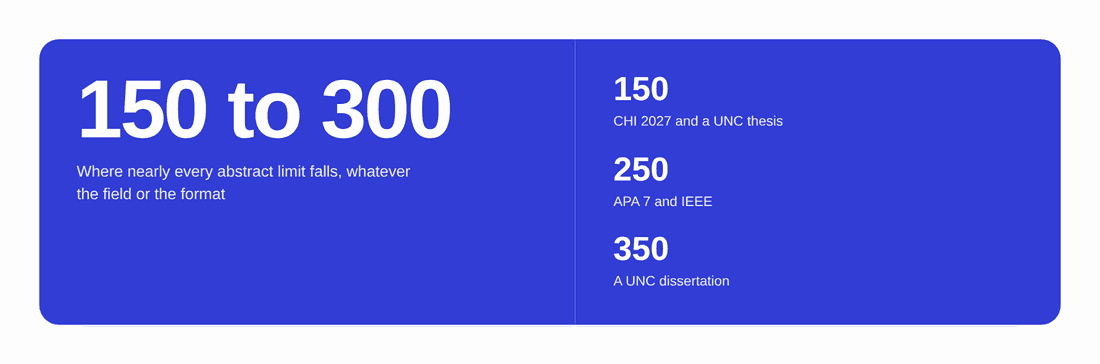
150 to 250 words. That covers most research abstracts, and it is the range APA 7 sets, Springer journals commonly ask for, and the University of Wisconsin Madison Writing Center teaches as roughly six to seven sentences.
Four numbers cover the rest: 100 or fewer for a descriptive abstract, 200 for Nature, 300 for PLOS ONE, 350 for a doctoral dissertation.
The limits, venue by venue
Venue | Limit | Notes |
|---|---|---|
CHI 2027 | 150 words or fewer | All submission types |
Nature | 200 words | Fully referenced summary paragraph |
Scientific Reports | 200 words | No references, no subheadings |
IEEE | 250 words | One paragraph, self contained |
APA 7 style | No more than 250 | Typically 150 to 250 |
PLOS ONE | 300 words | No citations |
American Academy of Neurology | 300 words, body only | Five headings required |
The BMJ | 250 to 300, up to 400 for a trial | Nine structured headings |
American Thoracic Society | 400 words | One table or figure allowed |
CHI 2027 gives you 150 words. The American Thoracic Society gives you 400. Same task, nearly triple the room.

Words or characters
Medical societies frequently count characters, and they disagree on what counts.
- ASCO: 2,600 characters excluding spaces, and the count includes your title and any table.
- AACR: 3,100 characters including spaces, and tables are banned.
- ASH: 4,500 characters including spaces.
A character cap changes your editing strategy. Long technical terms cost real budget, so defining an abbreviation once and reusing it saves space that trimming adjectives never will.
Theses and dissertations
Set by your institution, and shorter than most people expect. The UNC Chapel Hill Graduate School caps a thesis abstract at 150 words and a dissertation at 350.
A 150 word ceiling on an eighty page document is the hardest limit in academic writing. Drop the chapter tour and write only the question, the method, the finding and the argument.
What counts toward the limit
Almost always every word of the body, including structured headings. Usually excluded: the keywords line, the title, author names and trial registration numbers. Two things catch people out.
- Nine structured headings can eat twenty words before you write a sentence.
- Numbers with units, written as "95% CI 2.1 to 14.1", count as several words each. A results heavy abstract carries more overhead at the same apparent length.

The order to cut in
- Background to one sentence. Keep the one that makes the problem matter.
- Delete anything describing the paper rather than the study.
- Turn method descriptions into noun phrases. "We conducted a trial in which participants were assigned" becomes "In a trial, participants were assigned."
- Keep the numbers, cut the adjectives.
- Read the first and last sentences together. If they say the same thing, delete one.
Questions that come up at the counter
Is it bad to be well under?
Only if you left something out. A 180 word abstract naming the design, sample, effect and implication beats a 250 word one padded with context.
How many sentences is 250 words?
Around ten to twelve in academic prose. UW Madison puts 150 to 250 words at roughly six to seven sentences, which is a floor rather than a target.
Does the keywords line count?
Usually no. Keywords normally sit outside the count. Our guide to choosing research paper keywords covers what belongs there.
Hit the Number Without Losing the Study
A word limit is a filter, not an obstacle. Two hundred and fifty words is enough for the question, the design, the sample, the effect and what it means, and not enough for anything else. When you cannot fit inside the cap, the useful question is rarely what to cut but what you are including that is not the study.
For conference specific caps see our guide to writing an abstract for a conference, and a review pass will tell you whether what survived the cut still holds up.